In the article titled "How to Avoid a Bad Deal with Iran", it discusses how the U.S plans to stop the use of nuclear weapons by Iran by setting up negotiation dates with the leaders in Iran to push them towards getting rid of the dangerous weapons. The people of Iran refuse to agree with the prevention of using the nuclear weapons, so the U.S stated that they would "...rather the administration continue to negotiate than agree to a bad deal." The negotiations have been set to last up to another seven months because the U.S and other world power countries are not backing down and letting Iran use these weapons any longer. The negotiation agreements that the world power countries are making to Iran must follow the four main criteria. First, Washington must drastically reduce the number of centrifuges and also reduce the amount of uranium kept in stockpiles down to less than the minimum amount to construct one singular nuclear bomb. Second, there must be "unprecedented monitoring of all aspects of the Iranian nuclear program." Third, Tehran, an Iranian leader, must agree to all negotiations and all decisions to make sure that they can not use military force in part with them. And Lastly, "the sanction-relief mechanism should be gradual and in accordance with Iranian progress in rolling back the nuclear program." In the article it states that if negotiations do not follow these four main criteria, it then gives Iran and other Middle Eastern countries the right to acquire nuclear weapons.
This article on the U.S foreign policy could be used to apply the lasting principles of the Monroe Doctrine. It applies to the principle of separate spheres of influence because the U.S is afraid that Iran is going to use their nuclear weapons in attacking their country. So they think that if they can kindly negotiate the use of the weapons with Iran's leaders, then they wont use the weapons against the U.S in hopes that they can stay out of each others ways. Iran will keep to themselves and the U.S will keep to themselves. The article applies to non-colonization because the U.S is not settling and sitting in on Iran to make them stop the use of the weapons, they are simply negotiating with them to end the use. They are not invading their country. And finally, non-intervention applies to this article because the use of these weapons do not affect the U.S directly, but they want to make sure that it will end and not affect other countries. The Monroe Doctrine applies to the U.S foreign policy today in many ways. It is still active these days because the policies written are true to what the U.S should follow in foreign situations.
Citation of Article: "How to Avoid a Bad Deal With Iran." Foreign Policy How to Avoid a Bad Deal With Iran Comments. N.p., n.d. Web. 09 Dec. 2014.
Tuesday, December 9, 2014

Tuesday, December 2, 2014
Race and National Identity: Is it Becoming Too Serious of a Problem?
The revolution
that I had to study was the Brazil Revolution. The Brazil revolution all
started when Napoleon, the new French emperor, and his armies severed the
connections between Portugal and Brazil by invading Portugal and Spain in
1807-1808, right after the French Revolution had ended. When Napoleon went into
Spain, he imprisoned the Spanish King Ferdinand VII, which left the colonies
without royalty, thus starting a series of bloody wars fighting for
independence. Later on, in Brazil, French troops invaded and to avoid uprisings
like the ones that happened in Spain, the royal families of Brazil and 10,000 Portuguese
followers made a journey across the Atlantic and relocated their empire in Rio
de Janeiro. When the Portuguese prince, John VI, arrived in Brazil in 1808, he
was the ruler for thirteen years of Portugal’s Asian, African, and American
colonies in Rio de Janeiro. In 1815, King John VI elevated Brazil to the status
of a kingdom, and then shortly after, Napoleon was defeated in Europe, which
opened up new opportunities to reinstate the monarchy. However, John VI decided
to stay in Brazil, and then in 1820, the Portuguese army led a revolution to
bring about a constitutional government. Then in 1821, John VI gave up his leadership
position to his 23 year old son Pedro, and Pedro became prince regent of
Brazil. In 1822, Pedro declared Brazils independence, thus Brazil became one of
the first Latin American colonies to make a peaceful transition to
independence. And after creating a new constitution enacted in 1824, Portugal
finally recognized Brazil’s independence in 1825. Then, when Brazil was in a long
lasting struggle with Argentina over the Southern border of Brazil, it caused
the Cisplatine war that went from 1825-1828. Then when Brazil suffered defeat,
many people were unhappy with the way Pedro handled the war, thus Pedro abdicated
his Brazilian throne in 1831 and returned to Portugal. As you can see, there
were no real outbreaks due to race in the Brazil Revolution. After all, it was
the most peaceful transition to an independent colony in the Latin American
region. Its major outcomes were the takeover of the Southern border of Brazil
by the Argentineans, and the discovery of Rio de Janeiro when the Portuguese
fled when French troops invaded.
These days, race
continues to affect national identity and politics because there are many laws
written in the U.S that state that you can only do certain things if you are a
legal U.S citizen or if you were born in the country, etc. But now, these laws
are considered discriminatory because people are taking race very seriously now
and believe it is unfair to classify people by their race or background. In the
article by the New York Times titled “Reaction to Ferguson Decision Shows
Racial Divide Remains Over Views of Justice”, it talks about the white man that
shot the black teen and how the police officer who shot him was not being as
brutally punished because the kid he shot was black. This article shows how
race comes in to play in situations every day, and how people of other races
and backgrounds are still not treated as fairly as white people. I think that
this situation is horrible and that the police officer should be convicted just
the same as if he shot a white person because killing someone, no matter their
race, should come with the same consequences. Just been the teen was black does
not make it any better to have killed him. I believe that racial division is a
serious issue and it needs to be toned down and not taken into account as often
as it is.
Citation of article from the New York Times: Wines, Michael.
"Reaction to Ferguson Decision Shows Racial Divide Remains Over Views of
Justice." The New York Times. The New York Times, 25 Nov. 2014.
Web. 02 Dec. 2014. http://www.nytimes.com/2014/11/26/us/after-ferguson-announcement-a-racial-divide-remains-over-views-of-justice.html?_r=0
Friday, October 31, 2014
Should We Balance Power?
When people in power feel as though their power is being threatened, they should definitely take action. Obviously, no leader ever wants to be overthrown. In class, to learn about how Prince Clements von Metternich of Austria wanted to rule, we practiced, as his team of advisors, making decisions like we would have. We had a prompt of a real situation that happened when Metternich was in power, and we had three options on how to take action. We had to chose which option we though Metternich chose, and we had to explain why we thought he chose that option. Then after we discussed our choice, we talked about which choice Metternich made and we got to see who in the class made the correct choice according to Metternich. This activity taught us about how Prince Metternich handled his power being threatened, and what kind of a leader he was.
Metternich and the Congress of Vienna both used the strategy of Balance of Power. Balance of Power was the idea of equally distributing the power so that no one country was powerful enough to take over or dominate the others. Metternich used this strategy after Napoleon was defeated because they wanted to recreate some of the new boundaries of countries in Europe. He wanted to expand some more powerful countries like Austria and France, and establish some land for other small countries and territories because he did not like much the boundaries that Napoleon had set when he took over. The Congress of Vienna used this strategy too because with all the representatives in the congress, they all wanted different boundaries for their countries, so they had to compromise by using the Balance of Powers method.
I think that the Balance of Power method was a good choice for the Congress of Vienna and Metternich because it equaled out the power so there was no one over dominant country in Europe. This benefited everyone in Europe because everything was more equal. I think personally that in certain circumstances, yes, the people in power should sacrifice some of their power just to help out other countries or even their own countries. But obviously, no person in power wanted to be overthrown, so they have to keep in minimal as to who they give power to.
Metternich and the Congress of Vienna both used the strategy of Balance of Power. Balance of Power was the idea of equally distributing the power so that no one country was powerful enough to take over or dominate the others. Metternich used this strategy after Napoleon was defeated because they wanted to recreate some of the new boundaries of countries in Europe. He wanted to expand some more powerful countries like Austria and France, and establish some land for other small countries and territories because he did not like much the boundaries that Napoleon had set when he took over. The Congress of Vienna used this strategy too because with all the representatives in the congress, they all wanted different boundaries for their countries, so they had to compromise by using the Balance of Powers method.
I think that the Balance of Power method was a good choice for the Congress of Vienna and Metternich because it equaled out the power so there was no one over dominant country in Europe. This benefited everyone in Europe because everything was more equal. I think personally that in certain circumstances, yes, the people in power should sacrifice some of their power just to help out other countries or even their own countries. But obviously, no person in power wanted to be overthrown, so they have to keep in minimal as to who they give power to.
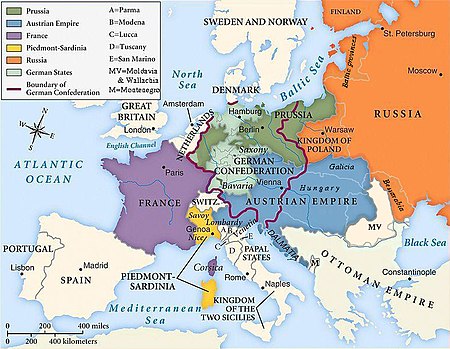 |
| Balance of Power Congress of Vienna (http://upload.wikimedia.org/wikipedia/commons/thumb/0/05/Map_congress_of_vienna.jpg/450px-Map_congress_of_vienna.jpg) |
Sunday, October 19, 2014
Was Napoleon a Good Leader?
Napoleon had a large impact on the social, economic, and political systems of Europe. He was a good leader and there were many people who believed his ideas were beneficial, but there were some who did not follow his same beliefs. It says in the article titled "The Lost Voices of Napoleonic History" that "...as an usurper, a tyrant, and a greedy, egotistical and ambitious ruler, it has also been found impossible to deny that his work, such as it was, was accomplished with an exquisite efficiency almost amounting to perfection". This quote shows that Napoleon, as egotistical as he was, did wonders for Europe, and had such a high work ethic that everything he accomplished was done so carefully and every plan was thought out. He really helped the people and had a big impact on social systems because he communicated his well thought out plans in such a way that made people trust that what he'd do was right for their country.
Napoleon helped the political system of Europe because he fought for Europe and protected the people. It says in the article of Marshal Michel Ney, "To the emperor Napoleon, our sovereign, belongs alone the right to rule over our beautiful country". This quote shows that the emperor Napoleon was trusted to rule Europe because he was loyal to the people. There are also negative impacts that Napoleon had on the political system such as the fact that he overthrew the Directory. This can be view as negative because, like Madame de Stael says, "I do not believe that when Bonaparte became head of the government he had yet formulated the plan for a universal monarchy". This can be viewed as negative because this shows that Napoleon was unorganized and did not quite have all of his ideas mapped out yet when he first became Emperor. So his impact on political systems can viewed either positively or negatively.
Finally, Napoleon impacted the economic system of Europe because he was a tyrant. Napoleon was a dictator, and he was viewed negatively for this. This affected the economic system because he ruled people with social classes, and there was a great divide between the clergy and the middle class and the poor. He had so many impacts on Europe that could be view as positive and negative, but overall he seemed as though he was a pretty organized and productive leader that lead Europe to some great successes and accomplishments.
Napoleon helped the political system of Europe because he fought for Europe and protected the people. It says in the article of Marshal Michel Ney, "To the emperor Napoleon, our sovereign, belongs alone the right to rule over our beautiful country". This quote shows that the emperor Napoleon was trusted to rule Europe because he was loyal to the people. There are also negative impacts that Napoleon had on the political system such as the fact that he overthrew the Directory. This can be view as negative because, like Madame de Stael says, "I do not believe that when Bonaparte became head of the government he had yet formulated the plan for a universal monarchy". This can be viewed as negative because this shows that Napoleon was unorganized and did not quite have all of his ideas mapped out yet when he first became Emperor. So his impact on political systems can viewed either positively or negatively.
Finally, Napoleon impacted the economic system of Europe because he was a tyrant. Napoleon was a dictator, and he was viewed negatively for this. This affected the economic system because he ruled people with social classes, and there was a great divide between the clergy and the middle class and the poor. He had so many impacts on Europe that could be view as positive and negative, but overall he seemed as though he was a pretty organized and productive leader that lead Europe to some great successes and accomplishments.
Thursday, October 9, 2014
A Taste of Capitalism
In class last
week, we did an activity using starbursts to represent capitalism, communism,
and socialism. When we first walked into the classroom, Ms. Bailey handed
everyone either three or ten starbursts. This was to represent the rich and the
poor in society. It was picked at random which students were “wealthy” and
which were not. At first, when everyone sat down in their seats and started to
notice that some people had more candy than others, people started to react. Some
students got angry that they had less; they thought it was unfair that others
had more. After everyone was settled, it was explained to us that the unequal distribution
of candy represented capitalism and how private ownership of industries got
some people more money than others. Then, to compete for the candy, we played
rock, paper, scissors, shoot to demonstrate the results in unequal economic
classes. When you chose someone to play against, and you lost, you had to give
them one of your candies. If you won, you gained one of your opponent’s
candies. After we had ten minutes of competition against our classmates, we all
sat back down in our seats with the candy we had collected. Some had more candy
than what they started with, others had less, and some students ended up with
no candy at all. Many of us were satisfied with the amounts of candy we had
collected, and expressed that the unequal division was now fairer because we
each worked hard for what we ended up with. But just as we thought our shares
had been finalized, our candy was all collected and pooled together then
redistributed in equal amounts to show socialism and how the industries owned
by the government had their money
collected and redistributed equally amongst a group of people. Socialism
demonstrates the idea that people are not always making what they work for
because the government has control over what money you keep, even though you were
the one who truly earned it. After the redistribution, communism had finally
been reached. We had met a classless society where everyone had the same amount
of candy. This activity was a fun hands on experience that easily and straight
forwardly taught us about capitalism, socialism, and communism.
It appears that
both Marx and Smith wanted to somehow help the poor people of society, but they
had very different approaches as to how to do so. Marx’s theory was based around
communism, capitalism, and socialism. He believed that in order to make things fairer,
there needed to be a more structured system of government such as socialism
that gave the government the right to equally distribute money to achieve a classless
society. This would help the poor because it gave them some money that they had
no way of making. Smith’s theory was called the Invisible Hand. The Invisible
Hand stated that there was to be no government control over any business and
that businesses would regulate themselves through supply and demand. It was
believed that businesses would offer lower prices or better goods to attract
more customers, and the competition between businesses would regulate the
market. This theory was believed to help the poor because the government had no
control over businesses and how they made their money and what they sold. So anyone
could make their own money and nit have to worry about it being collected and
evened out.
In my opinion,
Smith’s theory is the better one. I feel as though if you work hard to earn
your money, then you should be able to keep all of it for your own business and
not have to worry about it being collected and redistributed. There were people
who couldn’t earn money on their own, but even in that scenario; I still
believe that you should not be giving up what belongs to you to someone else.
Your hard work should not be taken away from you. The Invisible Hand was a well
developed system of how businesses would maintain themselves. It helped show that
the supply and demand of products was able to keep the government out of the
picture and prove that the people who were earning money on their own deserved
it because they were helping to regulate the market to keep their businesses up
and running.
Wednesday, October 8, 2014
The Luddites Are Causing Trouble
This is a mock primary source letter about the opposition of
the Luddites written by a skilled weaver living in Britain addressed to their
cousin in America.
Dear Cousin,How have things been over in the United States? Over here in Britain, there has been a new uprising of a group of people called the Luddites. The Luddites are people who oppose technological progress, and they have been causing problems lately here. There have been some stories going around about how they have been destroying machines in factories to protest the unfair pay and the unappreciative treatment they have been getting and also to show that they are against the methods in which technology is used. It is said that the government is feeling pretty threatened by these actions because they don’t want the movement to spread too far, but they don’t know much about how to stop it. Society has been on the verge of creating new technology for a long time, and now that we are finally in that period of growth, there are these people who are trying to prevent it by violently protesting. The reason behind their protests is that they thought technology was incorrect. They believed that industrialization was going to hurt society because of all of the new ideas and new equipment being made to help people to work in the factories. I personally believe that the Luddites are unjustifiably against technological uprising because it is becoming such a helpful part of people’s lives, and there’s no one way to completely get rid of it.
Being a skilled
weaver, and being in the position I am in working in the factories, I think
that the Luddites beliefs are wrong. Technology is a huge part of the work we
do in the factories, and it is helping to make things get done more efficiently
and easily. I am in large favor of the uprising of technology these days, and
the fact that the Luddites are imposing these negative views is not making the
factory owners too happy. I am personally fine with how I have been treated in
these mills, and I am glad that the new technology has been able to help me
with my work load. Industrialization had a huge effect on me because I was able
to go and work and make money for myself and live a life of independence. The
Luddites are wrong for their destructive behaviors. I think they should stop
what they’re doing and embrace the fact that technology is not going away, it’s
only getting more widespread.
Sincerely, Rachel
Friday, October 3, 2014
The Roles of Working Women
Women played a
huge role in industrialization. There were factories all over trying to hire
women who needed work to support their families. Unfortunately, the women were
treated like every other worker, and the conditions they were working in were
not ideal.
There were a few
main reasons as to what motivated women to go to work in the Lowell mills such
as wanting to help their families make more money, or to gain independence as a
maturing woman. Girls would often ask permission from their fathers to go to
the mills, they were never truly forced. Usually they decided on their own that
they wanted to go out and get a job so they could have the sense of
accomplishment that was making money to support themselves.
Women in Lowell
Massachusetts worked, on average, about 13 hours a day. They were paid very
little, close to about three dollars and fifty cents per six day week. This was
a huge drawback for girls working in the mills because they worked so hard and were
barely able to send home pay to their families. They worked as spinners,
warpers, weavers, dressers, and drawers in the factories, and the labor was
difficult. It says in the article titled Labor in Lowell that; “…most workers
had difficulty keeping up at first. But, with the help of more experienced
women, they learned to run spinning throstles, and other complicated machinery.”
This quote is a good example of what life in the factories was like for women
because it shows how they helped each other out when necessary. That was also
evident in the Lucy Hall video. When Lucy first went to work at the factory, an
older woman named Harriet helped her out a lot and took Lucy under her wing and
showed her how to work the machines. This was one of the benefits of the age
ranges in the workspaces because new and younger girls were able to ask for
assistance from older and more experienced women.
There were few opportunities
for working women in the 1800’s. But their attitudes were positive for the most
part. Many women wanted to be sent to work and they wanted to make their own
hard earned money. Regardless of the gender roles that may have been more
distinct, there were some women who still believed in working in factories
temporarily, and doing the physical labor that they had been doing all along. But
there were other roles that opened up that were believed to be filled by women like
staying home and being “…confined to the gentler world of home and family” , as
stated in the article titled The Changing World of American Women.
Women were
thought to be lesser than men, but during the industrialization period, women
really had a hand in the success of most factories. They proved that women
could work just as hard as men, and it seems as though the gender inequality
also played a large role in women’s motivation to work because they just wanted
to be seen as just as good as everyone else.
Tuesday, September 16, 2014
Curator For a Day
.JPG)
A curator is the
person who is in charge of a particular collection in a cultural heritage institute,
such as a museum. By doing this project, my group and I learned what it is like
to be a museum curator and what steps you have to go through to put together an
exhibit.
The first thing
we had to do was analyze five sources that had to do with our topic, which was
Slavery in the US, the Cotton Trade, and the Industrial Revolution. Our sources
were a picture of the Lowell Mill town, a map of the British cotton trade, a
graph of slavery population in different states in the US, a cartoon that
illustrated how slavery increased industrialization, and a short reading on the
inventions of Sir Richard Arkwright. My group came up with our exhibit title “Weaving
Slavery into the Industrial Revolution” by trying to tie in the main ideas of
all of the sources we used in creating our exhibit.
I hope that
people visiting my group’s exhibit will learn that slavery played a huge role
in the US during the Industrial Revolution. Slaves who worked in the cotton
industries made cotton more accessible. So when there was a higher demand for
cotton, it meant that the US needed more slaves to work in the industries, thus
putting more slaves to work, causing the slave population to increase, which
fueled the industrialization.
When we walked
around to look at exhibits put together by other groups in the class, I learned
a lot of things about the different topics that I did not expect and did not
know before. Looking at the exhibit about Child Labor, I learned that the
Factory Act of 1833 decreased working hours for children under 18. It also
stated that no children under the age of 9 were allowed to work in the
factories because it was a dangerous environment to be subjected to. From
another exhibit poster titled “Changes in Life Conditions due to the Industrial
Revolution” I learned that if the Industrial Revolution never happened,
factories and air pollution would be nonexistent. I also learned about
Cartwright and his invention of the Power Loom in Manchester UK in 1785. Another
exhibit titled “Fueling Transportation in the Industrial Revolution” I learned
that railroads were created in the 1840’s-1850’s by Williams Wordsworth and
Samuel Smiles. From the last exhibit I looked at called “A New Age is Looming over
the Horizon” I learned that the British Handloom was created in 1771 by John
Almond, and that looms were used by women in textile mills.
From being a
curator on a certain topic under the Industrial Revolution, I learned that t
was easier for me to focus on one specific topic, rather than a few different
ones all at once. But after looking around at other group’s exhibits, I ended
up learning a lot about the other topics in the Industrial Revolution, and I
was able to learn different things from my classmates, while teaching them what
I learned at the same time.
Subscribe to:
Posts (Atom)